Projects & research

Two theses, the research they grew into, and the software built from those findings.

← Back to home

With a tab focused, use ← / → to switch.

2026 TTS and accessible reading software

Nocturne

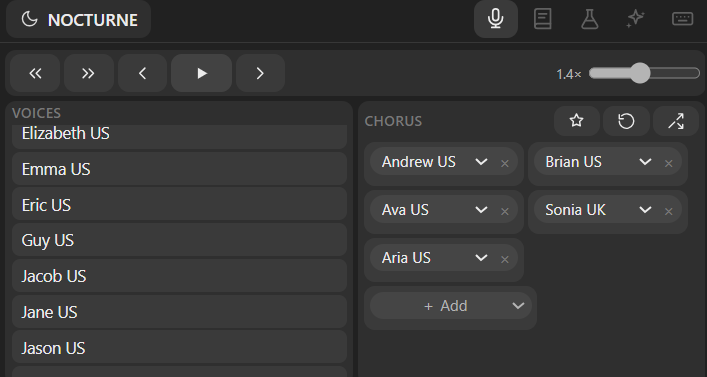
A browser extension that combines immersive reading, neural text-to-speech, synchronized highlighting, and AI assistance. Reading controls, word replacement, and site rules help people adapt web content to their needs.

Nocturne interface preview

Interface preview. Click to enlarge (opens in a new tab)

Expand to see details Collapse details : Nocturne

Nocturne

Nocturne brings listening, reading, and comprehension tools into one browser extension. Its audio controls support chapter and paragraph navigation, voice selection, playback speed, and synchronized word highlighting. The immersive reader removes surrounding page clutter and lets readers adjust typography, spacing, and themes.

Groq-powered tools explain or define selected text, paraphrase paragraphs, and answer questions about the page. AI features require the reader’s own Groq API key; they are optional alongside the reading controls. Keyboard shortcuts provide quick access to the reader and AI tools.

Reusable word-replacement lists simplify recurring terminology, while site-specific rules automate preferred reading settings. Built on Manifest V3 with an esbuild production build, Nocturne uses local storage for larger rule sets and synchronized storage for preferences. This work applies my research interest in making complex digital material easier to access and understand.

Browser extension · Manifest V3JavaScriptNeural text-to-speech and word highlightingGroq AI integrationChrome local and sync storageesbuild
Text-to-speechDigital accessibilityReading experience designAI-assisted comprehensionCognitive accessibility
2026 Climate-literacy learning experience

Canopy

A climate-literacy learning experience built from the thesis: plain language, inclusive characters, and multimodal science instead of badges and unexplained jargon.

Expand to see details Collapse details : Canopy

Canopy

A learning-experience build applying recommendations from my master's research. The analysis of 30 games identified opportunities to explain climate systems through visuals, sound, adaptive stories, and data-driven simulations, alongside barriers caused by jargon and limited representation. Canopy translates those design findings into maps, graphs, cause-and-effect scenes, an integrated glossary, and more inclusive characters and scenarios. Its structure is designed for modest connections.

Canopy complements the reading software on this site: Gloss supports understanding an article, Nocturne supports reading the page, and Canopy provides the climate lesson those tools can support.

Climate educationLearning designInclusive designMultimodal literacy
2026 Study companion software

Loop

A focus timer that keeps running in the background, one-click flashcards from any highlight, spaced-repetition review, and a jargon scanner that feeds straight into flashcards.

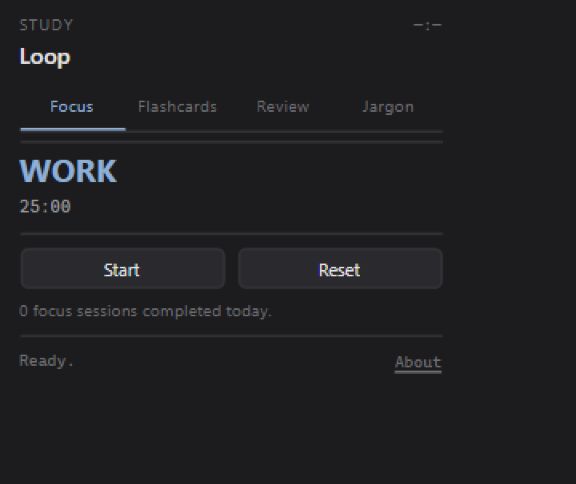
Loop interface preview

Popup interface preview, shown in its initial state. Click to enlarge (opens in a new tab)

Expand to see details Collapse details : Loop

Loop

Study companion software built around four parts that share real infrastructure rather than four separate apps bolted together.

Focus runs a Pomodoro-style timer — 25 minutes of work, a 5-minute break, a 15-minute break every fourth session — kept alive in the background so the session survives closing the panel, with a system notification when a phase ends. Flashcards turns a text selection into a card with one click, automatically attaching the source page and title so review material and citations build themselves as you read, rather than being a separate note-taking step.

Review runs those cards through a simplified SM-2 spaced-repetition schedule — grade each card Again, Good, or Easy, and the next-due date adjusts, so cards you know well show up less often and cards you don't come back sooner.

And because unfamiliar terms are one of the biggest drags on momentum while studying dense material, Jargon scans the current page against the same glossary used in Gloss and Scope, and lets you turn any flagged term straight into a flashcard.

Nothing is sent anywhere; flashcards, review schedule, and timer state all stay on the device. Loop is the study layer of the same software family: Nocturne makes the page readable, Gloss makes the claims checkable, Loop makes the learning stick.

Web softwareJavaScriptBackground timer with phase-end alertsSimplified SM-2 spaced-repetition schedulingShared glossary-based jargon detectionOn-device storage
Learning experience designSTEM educationStudy toolsClimate literacy
2025 Course accessibility software

Scope

Four views — Audit, Content, Simulate, History — that check common accessibility issues, course-content readability, impairment previews, and a site's score over time.

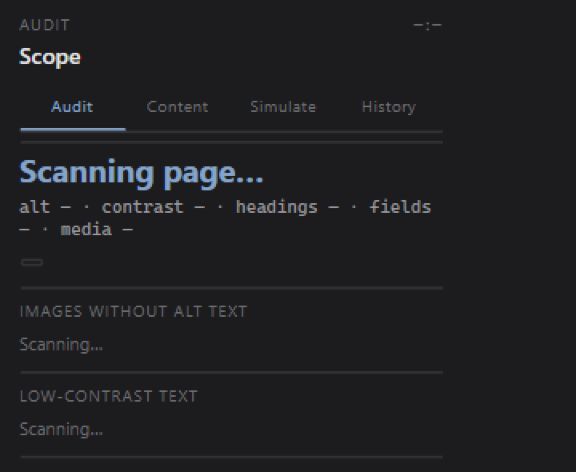
Scope interface preview

Popup interface preview, shown in its initial state. Click to enlarge (opens in a new tab)

Expand to see details Collapse details : Scope

Scope

Where Nocturne helps one person read a page more easily, Scope is built for the person who made the page in the first place — accessibility-audit software organized into four views rather than one flat report. Audit checks for missing alt text, low-contrast text sampled against real WCAG AA thresholds, broken or skipped heading order, unlabeled form fields, and missing captions or transcripts on video and embedded media — and recognizes common LMS platforms (Canvas, Moodle, Google Classroom, Blackboard) to give course pages more relevant context. Each finding comes with a suggested fix rather than just a flag: a filename-derived draft alt-text suggestion, a note to darken text or lighten a background, a corrected heading order.

Content turns the same readability and jargon-detection approach used in Gloss onto course material instead of news articles — a Flesch-Kincaid-style grade, a scan against the same climate-and-edtech glossary, and a structure read that flags dense or 'wall of text' writing.

Simulate previews the current page as it might look under protanopia, deuteranopia, tritanopia, full grayscale, a low-vision blur/contrast filter, or a rough dyslexia-style spacing approximation — real color-matrix filters and CSS, not illustrations, with an honest caveat that the dyslexia preview is an approximation for perspective-taking, not a validated simulation.

History keeps a local, per-site log of past scan results, so a team can tell whether their fixes are actually reducing the issue count over time, not just whether today's snapshot looks better. Scan results stay on the device: a timestamp and an issue count per site, never the page content. Scope is the authoring counterpart to Nocturne in the same software family.

Web softwareJavaScriptSampled WCAG AA contrast checkingLMS platform detection (Canvas, Moodle, Google Classroom, Blackboard)SVG color-matrix filters for colorblindness simulationOn-device per-site score history
Digital accessibilityWCAG-informed checksInclusive designLearning experience design
2024 Climate media-literacy software

Gloss

A reading toolkit that estimates credibility from page signals, compares climate figures with reference data, and defines jargon. It also helps readers find other coverage of the same story.

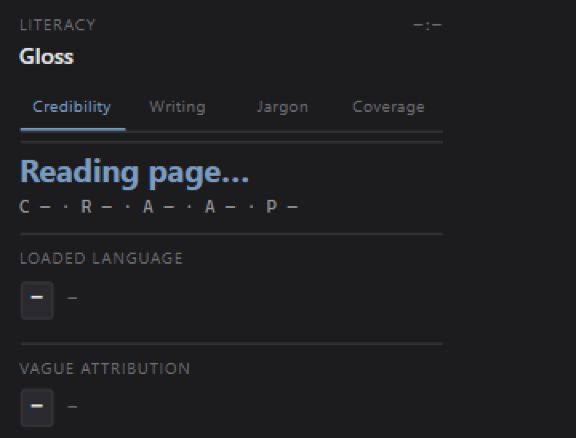
Gloss interface preview

Popup interface preview, shown in its initial state. Click to enlarge (opens in a new tab)

Expand to see details Collapse details : Gloss

Gloss

Most credibility tools stop at 'is this a real news site?' Gloss goes further, and does it with four features that work off the same read of the page rather than four separate tools bolted together. It scores any article in real time on currency, relevance, authority, accuracy, and purpose — the CRAAP framework I used to select and evaluate 30 climate-education games in my master's thesis — turning a research methodology into a heuristic reading, built from on-page signals, that a reader can run on any article, not just the ones I analyzed academically.

Alongside the credibility score, the software scans for climate-related numeric claims — a temperature figure, a CO2 concentration, a sea-level projection — and shows a well-established reference figure next to each one for comparison; it's deliberately built to inform, not to auto-verify, since a false sense of automated fact-checking would be worse than no tool at all.

Because unexplained scientific jargon was one of the clearest comprehension barriers my thesis findings identified, any glossary term on the page gets a plain-language definition, with an option to highlight matches directly in the article.

And because a single article is still a single perspective no matter how well-sourced it is, one click opens a search for other outlets currently covering the same story, so a narrowly-framed piece comes with an easy way to check it against wider coverage. The jargon glossary sits alongside Nocturne’s word-replace and AI define tools, so the software family feels like one set even though each runs independently.

The intended audience is anyone trying to evaluate climate or science information without a research background: students doing coursework, journalists fact-checking quickly, or a curious reader who wants a second opinion before sharing an article. It runs on the page you're already reading. Nothing is stored, and nothing is sent anywhere except the one search request if you choose to look up other coverage.

Web softwareJavaScriptOn-page CRAAP-style heuristic scoringPattern-matched climate-claim detection with static reference figuresGlossary-based jargon detection and in-page highlightingOne-click cross-source search
Science communicationMedia literacyClimate educationCRAAP framework
2023 Classroom connectivity software

Pulse

Diagnoses whether a connection can handle Zoom or Google Classroom, caches materials for offline use when it can't, and logs connection patterns over time.

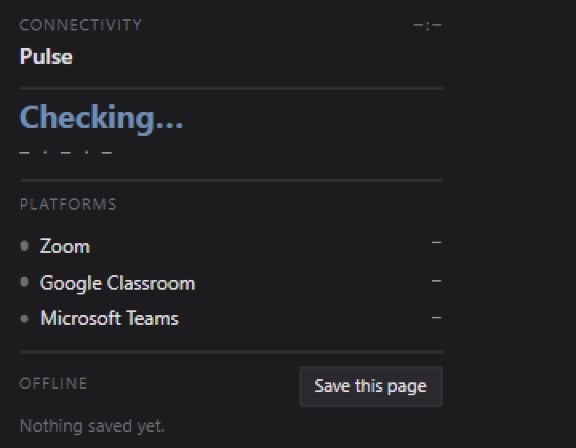
Pulse interface preview

Popup interface preview, shown in its initial state. Click to enlarge (opens in a new tab)

Expand to see details Collapse details : Pulse

Pulse

A generic 'you are connected to the internet' check is close to useless for remote learning — the real question is whether a specific connection can handle a live class without freezing or dropping audio, and what to do about it if it can't. Pulse answers both parts. It reads a quick network health signal (round-trip latency, estimated bandwidth, connection type) and translates the result into something concrete: a plain readiness read for Zoom, Google Classroom, and Microsoft Teams, with video platforms held to a stricter bar than a mostly-static page.

When the answer is marginal or poor, one click saves the page you're on — title and readable text — for offline reading later, so material is still reachable without a connection.

It also keeps a lightweight local log of every check, and once there's a handful of them at different times of day, it surfaces which hours tend to be best and worst, so a student or teacher can plan around the pattern instead of discovering the problem mid-class.

The idea traces directly back to my bachelor's thesis on e-learning infrastructure during COVID-19 in Bangladesh, where the digital divide and rural broadband access weren't abstract policy concerns — they were the reason entire classes couldn't attend school. Pulse is that research turned into a small, practical set of tools: diagnosis, offline access, and pattern awareness working together, reflecting my IT-support background applied to the same access problems the research uncovered.

Saved pages and connection history stay on the device. Pulse is the access layer of the software family that Nocturne, Gloss, Scope, and Loop continue.

Web softwareJavaScriptNetwork Information API with a timed-ping fallbackOne-click offline page captureOn-device connection history
IT supportDigital divideE-learning infrastructureOffline access
2026 Research project

New Foundations of Educational Technology

A critical look at AI, VR/AR, and hybrid video in education, focusing on access, implementation, and what meaningful learning requires.

Expand to see details Collapse details : New Foundations of Educational Technology

New Foundations of Educational Technology

An independent research project examining how AI, immersive technologies, and hybrid video are changing teaching and learning. Drawing on the critical framing of UBC's ETEC 511 course, I ask who designs these tools, how they are used, and what they mean for access, educator support, and institutional decision-making.

I compare the three technology areas through adoption, evidence on learning, implementation demands, and equity. UNESCO's 2023 survey of more than 450 schools and universities found that fewer than 10% had formal guidance on generative AI. The OECD's 2026 Digital Education Outlook makes a related distinction: better task performance with AI does not necessarily mean lasting learning, and educational design matters.

The synthesis considers AI as a layer connecting immersive and collaborative tools, alongside questions about accessibility, governance, and teacher preparation. This extends my earlier work on representation and accessibility in climate-education platforms, with practical implications for evaluating new learning technologies.

Artificial intelligence in educationImmersive learningHybrid & synchronous learningCritical EdTech research

Full report available on request.

2025 Master’s research

Digital Tools and Climate Literacy

A multimodal discourse analysis of 30 climate-education games — how design, sound, and story build climate literacy, and where representation still falls short.

Expand to see details Collapse details : Digital Tools and Climate Literacy

Digital Tools and Climate Literacy

Master's thesis at the University of Calgary (Werklund School of Education), examining the role of digital games in climate change education (CCE). Working within a constructivist framework, I used multimodal discourse analysis to read 30 climate-education games across their textual, visual, audio, and interactive layers, selecting each title with the CRAAP framework (currency, relevance, authority, accuracy, purpose).

The research answered three questions: how games represent climate discourse through their design; how well they handle inclusion and accessibility, including gender representation and technological access; and what the findings mean in practice for educators, developers, and learners.

Findings showed that visual devices — graphs, maps, a forest shrinking as emissions rise — make abstract climate science tangible, and ambient audio (wind, melting ice) deepens emotional engagement, while unexplained scientific jargon and repetitive sound design undercut both for younger players. The analysis identified stronger opportunities for explaining climate systems in adaptive stories and data-driven simulations than in simple point-and-badge reward systems.

The clearest gap: most games use neutral, generic characters and never address the gendered dimensions of climate change — who is most affected by resource scarcity, and who leads on solutions — despite women being more likely to take real-world climate action. The thesis closes with concrete recommendations for game developers (build inclusive characters, simplify without flattening the science), educators (use games to supplement, not replace, curricula), and policymakers, and was presented at three conferences in 2025.

Sources & related work

GamificationMultimodal discourse analysisClimate literacyInclusive design

Talks from this work

Manuscript available on request.

2025 Research project

Inclusion Gaps in Climate Games

Who climate-education games represent, and who they leave out — a close read of gender, accessibility, and design equity across 30 games.

Expand to see details Collapse details : Inclusion Gaps in Climate Games

Inclusion Gaps in Climate Games

The equity-focused strand of the master's research: a close read of inclusion and accessibility across the same 30-game corpus, built around research question 2 of the thesis — how are gender dynamics and technological accessibility represented in digital climate games? The pattern was consistent: most games default to neutral or generic player characters, and none directly address the gendered impacts of climate change — the disproportionate effect of resource scarcity on women in vulnerable regions, or women's outsized role in sustainability leadership — even though a few titles gesture at diversity through surface-level character design.

On the accessibility side, unexplained scientific jargon and static or repetitive audio consistently created barriers, particularly for younger and less experienced players, even in games that were otherwise well designed.

The output isn't only critique: the analysis translates into specific recommendations for developers — build gender-aware narratives and characters, and simplify scientific language without losing depth — aimed at closing the gap between who plays these games and who they're actually built for. Those recommendations feed Canopy, Nocturne, and Gloss: the learning experience and software that followed this research.

Sources & related work

Inclusive designAccessibilityRepresentationUI / UX evaluation
2024 Research project

Evaluating Climate-Education Platforms

Heuristic evaluation of 30 climate-education games, selected with the CRAAP framework and read across engagement type, learning focus, and interactivity level.

Expand to see details Collapse details : Evaluating Climate-Education Platforms

Evaluating Climate-Education Platforms

The methodology-and-evaluation strand of the master's research: selecting and heuristically reading the 30-game corpus that the wider thesis analyzed. Games were screened with the CRAAP framework (currency, relevance, authority, accuracy, purpose) and then read across four layers — text, visuals, audio, and interactivity — to see what each one actually teaches and how clearly. The corpus ranged from strategy titles like Super Energy Apocalypse: Recycled (energy and pollution management) and Sustainable Shaun (resource balancing), to satire like Climate Change Simulator 2018, to data-grounded tools like the UK government's MacKay Carbon Calculator, which simulates climate projections to 2100 for roughly 30 nations, and platforms such as En-ROADS and STOP Disasters! that this site's climate-games directory also features.

Each game was logged for engagement type (serious vs. entertainment), learning focus, and interactivity level, surfacing which design patterns — narrative-driven simulation over static badge systems — could support engagement and understanding; the analysis evaluated design rather than measuring learners' outcomes. That same CRAAP read later became Gloss: scoring currency, relevance, authority, accuracy, and purpose on any article, not only the games in the study.

Sources & related work

UX researchHeuristic evaluationGamified learningScience communication
2024 Research project

AR/VR for Environmental Learning

A literature-grounded feasibility read on AR and VR for environmental learning — where immersive tools help, and where a simpler tool still wins.

Expand to see details Collapse details : AR/VR for Environmental Learning

AR/VR for Environmental Learning

Graduate research at the University of Calgary asking whether augmented and virtual reality are classroom-ready for environmental and climate learning, grown out of the same literature review that underpins the master's thesis. AR shows real promise for teaching multimodal literacies and making abstract climate concepts concrete, but only with dedicated teacher training behind it. VR research on brief immersive lessons in Italian secondary schools found genuine post-pandemic gains in student interest and engagement, alongside open concerns about cost, access, and classroom readiness. Related work on AR/VR in sustainable-horticulture education pointed the same direction.

Looking forward, the review outlines where VR could go next in CCE — simulating rising sea levels or disappearing forests to make consequences experiential rather than abstract — while staying grounded in a practical conclusion: immersive tools help when the pedagogy and teacher support exist to back them, and a simpler digital tool is often still the better design choice today. That conclusion is the bridge to New Foundations of Educational Technology, which picks up immersive tools again in 2026 — this time as part of a wider convergence with AI and hybrid video.

Sources & related work

AR / VRFeasibilityEnvironmental learningLiterature review
2021 Bachelor’s thesis

E-Learning and Crisis Resilience

How Bangladesh’s education system stayed online during COVID-19 — access, infrastructure, burnout, and hybrid futures.

Expand to see details Collapse details : E-Learning and Crisis Resilience

E-Learning and Crisis Resilience

Bachelor’s thesis at the University of Dhaka: a mixed-methods study of e-learning during COVID-19 in Bangladesh. I surveyed students and educators on the digital divide, the cost of connectivity, and the psychological load of isolated learning. The work mapped the public and private platforms that kept teaching going, and argued that hybrid models would stay after the emergency ended. Pulse, the classroom connectivity software, is the direct practical follow-on: diagnosis and offline access for the same infrastructure problems this thesis named.

Sources & related work

Disaster scienceDigital infrastructureMixed methodsAccess and equity

Platforms studied

National and government infrastructure

  • Sangsad TV (Amar Ghore Amar School) — State television lessons for rural learners when broadband was out of reach.
  • MuktoPaath — National e-learning platform that scaled educator training during the shift to digital teaching.
  • BdREN — Research and education network that kept university access and Zoom infrastructure alive.

Private EdTech and global tools

  • 10 Minute School — Bangladesh’s largest EdTech platform — local video, quizzes, and a mobile-first classroom.
  • Shikho — Curriculum-aligned lessons and micro-learning built for local learners.
  • Zoom / Teams — Synchronous tools evaluated under real bandwidth limits and long-term remote fatigue.

Manuscript available on request.

Climate & environment games I study and recommend

These tools sit at the centre of the 2024–2025 research: how digital and game-like experiences can build climate literacy — or miss accessibility and inclusion. I used multimodal analysis on platforms like these to ask what they teach, who they invite in, and what they leave out.

How this ties to my work

Policy simulation

En-ROADS Climate Solutions Simulator

MIT Sloan / Climate Interactive. Sliders for energy, transport, and policy show global temperature paths to 2100.

Expand to see details Collapse details : En-ROADS Climate Solutions Simulator

En-ROADS Climate Solutions Simulator

Connection to my work: Core reference in my climate-education work: systems thinking + instant feedback is exactly the kind of multimodal design I analysed for literacy and inclusion gaps.

Move policy sliders and watch temperature, air quality, and equity outcomes update live. Great for workshops.

Open game →
Role-play workshop

Climate Action Simulation

Live negotiation game: players act as countries and industries at a climate summit.

Expand to see details Collapse details : Climate Action Simulation

Climate Action Simulation

Connection to my work: Shows climate learning as social, not just solo screen time — useful when I talk about engagement and classroom facilitation.

Take a role, bargain, then test agreements in En-ROADS.

Open game →
Disaster risk education

STOP Disasters!

UNDRR free browser game. Build safer towns against floods, earthquakes, wildfires, and more.

Expand to see details Collapse details : STOP Disasters!

STOP Disasters!

Connection to my work: Direct bridge from my B.Sc. in disaster science: risk, vulnerability, and community resilience taught through play.

Pick a hazard scenario, budget limited resources, and reduce risk before disaster hits.

Open game →
Browser narrative sim

The FT Climate Game

Financial Times net-zero challenge backed by IEA-style data.

Expand to see details Collapse details : The FT Climate Game

The FT Climate Game

Connection to my work: A polished news-game example of climate literacy for adults — good contrast case for UX clarity vs. depth in my evaluations.

Make sector decisions from the 2020s onward and try to hit net zero by 2050.

Open game →
Interactive fiction

Survive the Century

SESNC narrative: political and social choices across 100 years of climate futures.

Expand to see details Collapse details : Survive the Century

Survive the Century

Connection to my work: Narrative multimodality (text + consequence) is part of what I studied for how stories teach climate agency.

Choose as a global editor; see cascading environmental and social outcomes.

Open game →
Collaborative card workshop

Climate Fresk

IPCC-based card mapping used by millions of participants worldwide.

Expand to see details Collapse details : Climate Fresk

Climate Fresk

Connection to my work: Facilitated learning design — pairs with my interest in how people co-construct understanding, not just click through content.

In groups, arrange cause–effect cards to rebuild the climate system story.

Open game →
Full climate and environment directory 6 categories
Policy & systems simulators 5 tools
  • En-ROADS — Global climate policy simulator (MIT / Climate Interactive).

    Link to my work: Primary systems-literacy example in my digital climate education research.

  • C-ROADS — World Climate Simulation model used in COP-style role-plays.

    Link to my work: Shows negotiation + modelling — same literacy goals I studied for classroom and public use.

  • World Climate Simulation — Facilitated role-play built around C-ROADS.

    Link to my work: Social learning + climate data — useful when I discuss engagement beyond single-player apps.

  • The Road to 10 Gigatons — Carbon-removal portfolio explorer against IPCC-scale goals.

    Link to my work: Specialised climate content: good case for whether tools explain trade-offs accessibly.

  • Carbon City Zero — City-scale decarbonisation card/board experience (digital resources available).

    Link to my work: Local climate action framing — complements global simulators in my EdTech comparisons.

Disaster, risk & resilience 3 tools
  • STOP Disasters! — UNDRR disaster risk reduction game (flood, quake, wildfire, tsunami, and more).

    Link to my work: Closest digital cousin to my disaster science training — risk reduction taught by doing.

  • Ready.gov games & kids resources — U.S. preparedness activities and games for households and youth.

    Link to my work: Public risk communication design — how agencies teach preparedness without jargon.

  • FloodSim (historical / research lineage) — Classic public flood-policy simulation used in UK engagement experiments.

    Link to my work: Early example of policy games for environmental risk — context for today’s climate sims.

Browser & newsroom climate games 4 tools
  • The FT Climate Game — Financial Times net-zero management game.

    Link to my work: High-production UX case study in adult climate literacy media.

  • Survive the Century — Interactive fiction on century-long climate politics.

    Link to my work: Story + consequence multimodality — central to my discourse analysis approach.

  • BBC Climate Challenge (classic) — Older BBC strategy game on climate policy trade-offs (may need archive access).

    Link to my work: Historical baseline for how news orgs taught climate systems through play.

  • EnerCities — European energy-and-city management learning game lineage.

    Link to my work: Education-first design for youth — useful contrast to entertainment climate games.

PC / commercial climate & eco games 6 tools
  • Terra Nil — Reverse city-builder: restore ecosystems, then leave no trace.

    Link to my work: Restoration narrative vs. extractive sim tropes — rich for critical media analysis in CCE.

  • Beecarbonize — Card strategy where emissions are the antagonist.

    Link to my work: Systems cards map science → action; good for discussing game mechanics as pedagogy.

  • The Climate Trail — Free survival RPG on climate-displaced migration.

    Link to my work: Human mobility and justice themes — extends climate literacy beyond ‘parts-per-million’.

  • Fate of the World — Long-horizon global strategy with climate science advisors.

    Link to my work: Complexity vs. learnability — exactly the tension my UX-style evaluations care about.

  • Eco — Multiplayer civ builder where pollution can lose the server before the meteor does.

    Link to my work: Collective action problem in multiplayer form — mirrors real climate cooperation dilemmas.

  • Plasticity — A puzzle-platformer about choices in a world damaged by plastic waste.

    Link to my work: A case for examining how environmental choices are represented through story and gameplay.

Science agencies & classroom tools 3 tools
  • NASA Climate Kids – Play — NASA mini-games on carbon, energy, and Earth systems for younger learners.

    Link to my work: Age-appropriate climate media — important when I discuss accessibility and audience design.

  • NASA Eyes on the Earth — 3D real Earth data visualisation (CO₂, sea level, satellites).

    Link to my work: Data visualisation as learning tool — pairs with GIS/climate communication skills I use.

  • Minecraft Education – Climate & sustainability lessons — Lesson worlds on climate, energy, and ecosystems inside Minecraft Education.

    Link to my work: Classroom EdTech stack — bridges my Google Educator training and climate content design.

Workshops & tabletop 4 tools
  • Climate Fresk — IPCC cause–effect card workshop.

    Link to my work: Facilitation-first climate literacy — complements digital tools I evaluated.

  • Daybreak — Co-op board game on global decarbonisation (QR-linked science).

    Link to my work: Hybrid physical/digital science links — interesting multimodality case.

  • Keep Cool — Country-bloc board game on growth vs. climate protection.

    Link to my work: Negotiation dynamics studied in climate education literature I draw on.

  • Catan: New Energies — Catan variant with fossil vs. renewable power and pollution.

    Link to my work: Familiar game grammar teaching energy trade-offs — good ‘transfer’ example for learners.

Master's Thesis (2025) | University of Calgary

Digital Tools & Climate Change Education

Analysed how digital games communicate climate science through text, visuals, sound, and interaction. The research identified opportunities for clearer and more inclusive learning experiences.

Expand to see details Collapse details : Digital Tools & Climate Change Education

Digital Tools & Climate Change Education

Examined climate-education games through a constructivist framework and multimodal discourse analysis. The study analysed text, visuals, sound, and interaction, identifying opportunities to explain complex climate concepts more clearly. Its recommendations address scientific language, gender representation, accessibility, and inclusive design.

GamificationMultimodal Discourse AnalysisUI/UX EvaluationClimate Literacy

Request the manuscript →

Bachelor's Thesis (2021) | University of Dhaka

E-Learning Infrastructure & Crisis Resilience

Examined how students and educators in Bangladesh accessed e-learning during COVID-19. The study explored infrastructure, affordability, and the challenges of isolated learning.

Expand to see details Collapse details : E-Learning Infrastructure & Crisis Resilience

E-Learning Infrastructure & Crisis Resilience

A mixed-methods study of e-learning during COVID-19 in Bangladesh, using online surveys to examine students' and educators' experiences. The research explored the digital divide, connectivity costs, and the challenges of isolated learning. It mapped the public and private platforms supporting remote teaching and considered the role of hybrid learning after the emergency.

Disaster Science & Climate ResilienceDigital Infrastructure EvaluationMixed-Methods SurveyingEdTech Accessibility

Request the manuscript →